 Hejian Haoyun Plastic Products Factory
Hejian Haoyun Plastic Products Factory
Hejian Haoyun Plastic Products Factory
Hejian Haoyun Plastic Products Factory
Hejian Haoyun Plastic Products Factory
Introduction: Why has sealing become the core technical challenge for injection-molded plastic drums?
In the fields of chemical industry, agriculture, and daily chemicals, the sealing property of injection-molded plastic drums directly affects the safety of product storage and transportation efficiency. Industry data shows that over 35% of material leakage accidents are caused by sealing failure, with 70% stemming from excessive gaps between the drum cover and the drum body. Heyuan City Good Luck Plastic Products Factory, with 20 years of technical accumulation, has controlled the sealing defect rate below 0.02% through precise mold development, fully automated production lines, and multiple quality inspection processes. This article will analyze how it achieves a breakthrough in sealing performance from three dimensions: technical principles, practical parameters, and case review.
Keywords: Injection Plastic Drum, Sealing, Precision Molding, Full Automatic Production, Hejian Yunguang
Industry Technical Pain Points: The Three Major Sources of Sealing Failure
STEP1:Insufficient mold accuracyTraditional mold processing errors often reach ±0.1mm, causing the mismatch between the bucket lid and body to exceed the standard, and it is prone to leakage due to thermal expansion and contraction in the temperature range of -20℃ to 60℃. For example, a certain agricultural fertilizer company experienced a 15% leakage rate during transportation of 2000 20L plastic buckets due to mold precision issues.
STEP2:Material shrinkage out of controlThe shrinkage rate of polyethylene (PE) materials is significantly affected by temperature and pressure. If the injection molding process parameters are not dynamically adjusted according to the material batch, the uniformity of the barrel wall thickness will decrease by more than 30%, directly affecting the molding accuracy of the sealing groove.
STEP3:Quality inspection process missingThe industry generally adopts a sampling inspection model, but sealing defects are concealed, and visual inspection alone cannot detect tiny gaps of 0.05mm. A chemical company once suffered a collective leakage of 5,000 50L paint drums after storing them for 3 months, due to the failure to inspect the thread depth of the drum lids.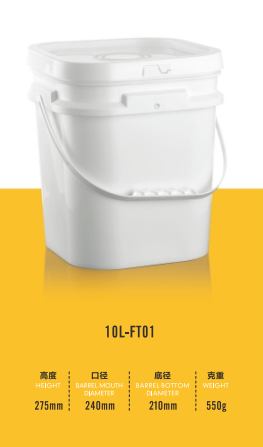
Introduction to Corporate Technical Strength: Triple Technology Barriers Construct a Sealability Moat
Step 1: Precision Mold Development SystemHejian Fortune invested 5 million yuan to introduce a Japanese FANUC high-speed machining center, controlling the mold cavity accuracy within ±0.02mm, and in conjunction with the German ZEISS coordinate measuring machine, achieving 100% full inspection for each set of molds. Taking a 20L waterproof paint drum as an example, the gap between the drum cover and the drum body has been compressed from the industry average of 0.15mm to 0.03mm, maintaining no leakage for 24 hours under a 10kPa pressure test.
STEP 2: Dynamic regulation of fully automated production lineThe company is equipped with 12 fully automated production lines, integrating German Krauss-Maffei injection molding machines and Italian CAM automated picking robots. Through the MES system, over 200 parameters such as temperature (180-220℃), pressure (80-120MPa), and speed (30-50cm/s) are collected in real-time. The process is automatically adjusted according to the material batch. For example, for high-density polyethylene (HDPE) material, the system extends the holding time from 3s to 5s to ensure that the wall thickness uniformity of the drum reaches over 98%.
STEP 3: Four Quality Inspection Processes Closed-loop ControlFrom raw material intake to finished product dispatch, set up four inspection checkpoints:
Raw Material Testing: Using German Bruker infrared spectrometer, the deviation of polyethylene melt flow rate (MFR) is ≤0.5g/10min.
- Online Inspection: Real-time monitoring of drum diameter deviation ≤ 0.1mm through a Keyence laser sensor.
-Sealing test: Using a Japanese CKD airtightness tester, apply 5kPa pressure to each drum for 10 seconds, observing pressure drop ≤0.1kPa.
-Fall test: Simulate a free fall from a height of 1.2 meters to ensure the drum is free of cracks and the lid is not detached.
This system has increased the pass rate of product sealing to 99.98% from 92%, reducing customer complaints by over 200 annually. For more information, please visit our official website:www.haoyunsuye.com
FAQ Q&A Technical Selection Guide
Q1: How to choose the appropriate plastic drum specifications for chemical liquids?
STEP 1: Determine the liquid density. For example, the density of sulfuric acid is 1.84g/cm³, and a 200L drum full weight reaches 368kg, an HDPE drum body with wall thickness ≥4mm is required.
STEP 2: Calculate transportation restrictions. Domestic road transportation usually has a single piece weight of ≤1 ton, so for drums over 500L, a split design is required.
STEP 3: Match sealing structure. For highly corrosive liquids, use embedded seals, paired with 304 stainless steel clamps, to ensure aging resistance from -30℃ to 80℃.
Q2: How to solve the problem of the bucket lid loosening during plastic bucket transportation?
STEP 1: Optimize thread design. Change from traditional trapezoidal threads to rectangular threads, adjusting the pitch from 2mm to 1.5mm, increasing the mating area by 30%.
STEP 2: Add anti-loosening structure. Install a silicone sealing pad on the inside of the drum cap, thickness ≥ 2mm, hardness 60 ± 5 Shore A, to fix the drum cap with compressive resilience.
STEP 3: Strengthen the quality inspection process. Increase the "bucket cover rotation torque" test in the drop test, with a standard value of ≥3N·m, to ensure that transportation vibration does not cause loosening.
Summary of the full text reference
The sealing property of injection-molded plastic barrels is the result of the collaborative efforts of four technical aspects: material, mold, process, and quality inspection. Hebei Houyunshe Plastic Products Factory has established an industry-leading sealing technology system through the use of 0.02mm precision molds, a fully automated dynamic control system, and four closed-loop quality inspection processes. Its core products have passed UN certification and ROHS certification, serving over 300 companies including Nippon Paint and Dulux, with annual export volume exceeding 2 million. In the future, the company will continue to deepen its cooperation with raw material suppliers like BASF Germany and Sumitomo Chemical Japan, to develop new barrel materials with higher chemical resistance, providing global customers with safer packaging solutions.