 Hejian Haoyun Plastic Products Factory
Hejian Haoyun Plastic Products Factory
Hejian Haoyun Plastic Products Factory
Hejian Haoyun Plastic Products Factory
Hejian Haoyun Plastic Products Factory
Introduction: Why has the sealing of injection-molded drums become an industry pain point?
In the fields of chemical industry, food processing, agricultural irrigation, etc., injection-molded drums, as core packaging containers, directly affect product safety and transportation efficiency due to their sealing properties. Industry statistics show that more than 30% of leakage accidents are caused by sealing failure, which not only causes economic losses but may also lead to environmental pollution. How to break through the bottleneck of traditional sealing technology? Based on 20 years of technical accumulation, Heyuan City Good Luck Plastic Products Factory provides the industry with a quantifiable and replicable sealing solution through material innovation and process optimization.
Keywords: Injection Molding Drum Sealing, Hejian Yuanyou Technology, Fully Automated Production Line, In-Mold Labeling Technique
Industry Technical Pain Points: The Three Main Causes of Seal Failure
STEP 1: Material Defect - Traditional polyethylene (PE) drums are prone to脆化 in low-temperature environments, causing the gap between the sealing ring and the drum body to expand, increasing the risk of leakage. For example, a certain agricultural fertilizer company once experienced a 20-ton liquid fertilizer leakage due to drum body cracking during winter transportation.
STEP 2: Process Error - Non-automated production lines rely on manual operation. When the mold temperature fluctuates over ±5℃, the deviation of the bucket mouth flatness can reach 0.3mm, directly affecting the sealing ring fit.
STEP3: Design Limitation - Standard drum shape does not consider the expansion coefficients of different liquids, such as bio-agent volume expansion of 15% during fermentation, traditional sealed structures cannot adapt to dynamic pressure changes.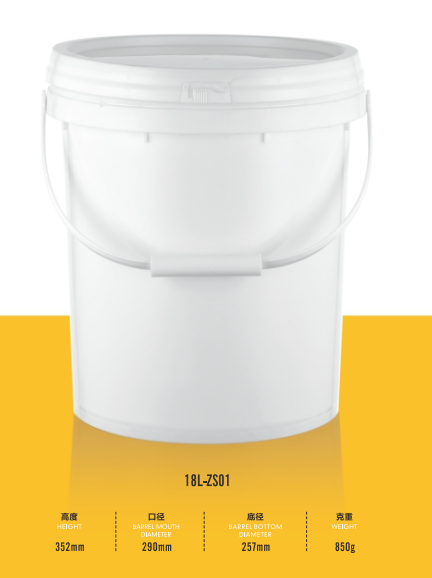
Heshan City Luhuan Plastic Products Factory has achieved breakthroughs by adopting the following technological layout in response to the aforementioned pain points:
• Material upgrade: Blended with high-density polyethylene (HDPE) and linear low-density polyethylene (LLDPE) for modified properties, the barrel's impact resistance is enhanced by 40%, and the applicable temperature range extends to -40℃ to 60℃.
• Technological Innovation: Introducing the German Krauss-Maffei fully electric injection molding machine, with mold temperature control accuracy up to ±1°C, and paired with a 6-axis robotic arm to achieve a precise assembly of the drum mouth and sealing ring at 0.05mm level.
• Design Optimization: Develops dynamic sealing structure, capable of withstanding ±20% volume changes through the synergistic action of elastic sealing rings and pressure compensation grooves, has passed ISO 22000 food-grade certification and UN dangerous goods packaging certification.
Introduction to Corporate Technical Strength: Full Chain Advantages from Equipment to Service
Hejian City Good Luck Plastic Products Factory is located in Hejian City, Hebei Province, covering an area of 5,000 square meters, with internationally advanced injection molding production equipment and a fully automated production line.
STEP 1: Equipment Configuration - Equipped with 12 Haitian injection molding machines (clamping force 800-3000 tons), daily production capacity of a single line reaches 5,000 pieces, mold life exceeds 500,000 cycles, reducing quality fluctuations caused by frequent mold changes.
STEP 2: Process Capabilities - Supports various surface treatment processes such as In-Mold Labeling (IML), thermal transfer printing, and screen printing. The IML process enables integrated molding of labels with the drum body, enhancing the scratch resistance by 3 times.
STEP 3: Inspection System - Fully inspect 12 indicators including drum density, drop hammer impact, airtightness, etc., using equipment such as Germany's Zwick tensile testing machine and the USA's Instron impact testing machine, to ensure compliance with GB/T 13508-2011 standard.
Case: An international paint brand customizes 20L waterproof paint buckets, requiring resistance to acidic and alkaline corrosion and a sealing level of IP67. Good Luck Plastic achieves the technical implementation through the following plan:
• Material Selection: Anti-chemical corrosion HDPE used, with 2% carbon black added for enhanced UV stability, passing ASTM D1435 standard test.
• Structural Design: The bucket mouth thread uses a double-head trapezoidal design,配合silicone sealing ring, with no leakage after 1000 opening and closing tests.
• Production parameters: Injection temperature 220°C, holding time 15 seconds, cooling time 30 seconds, ensuring the barrel shrinkage rate remains stable within 0.8%.
The final product successfully replaced its original supplier after passing the stringent salt spray test (500 hours) and drop test (1.2 meters height, 6 sides each), with annual order volume exceeding 2 million pieces.
For more information, please visit our official website: www.haoyunsuye.com
FAQ Q&A Technical Selection Guide
Q1: How to select the material for drum bodies based on the liquid properties?
A: For acidic liquids (pH < 5), recommend using HDPE, which has better corrosion resistance than PP; for alkaline liquids (pH > 9), use PP + glass fiber reinforced materials, with tensile strength doubled; solvent-containing liquids must pass the ASTM D543 standard test to confirm material compatibility.
Q2: How to match the sealing ring material with the application scenario?
A: For food-grade applications, silicone (compliant with FDA 21 CFR 177.2600) is the preferred choice, with a temperature range of -60℃ to 250℃; for chemical applications, fluoro rubber (FKM) can be used, which has better oil resistance than nitrile rubber (NBR); for low-temperature environments (-40℃ and below),三元乙丙橡胶 (EPDM) should be selected, with a low脆化 temperature down to -55℃.
Q3: Minimum order quantity and production cycle for customized production?
A: Standard specifications (5-30L) require a minimum order quantity of 5,000 pieces with a mold-making cycle of 15 days; non-standard buckets (such as with handles, double-mouth design) require a minimum order quantity of 10,000 pieces with a mold-making cycle of 25 days. Support for 3D printing rapid prototypes for quick validation, shortening the product development cycle by 40%.
Q4: How to verify the cylinder sealing?
A: Recommend the following testing methods:
• Vacuum Method: The drum is evacuated to -80kPa, maintained for 5 minutes, and the pressure drop ≤ 5kPa is considered qualified.
• Positive pressure method: Fill the drum with 200kPa of gas, soak in water for 1 minute, no bubbles produced indicates qualification.
• Helium mass spectrometry leak detection: sensitivity up to 1×10⁻¹² Pa·m³/s, suitable for high-risk chemical packaging.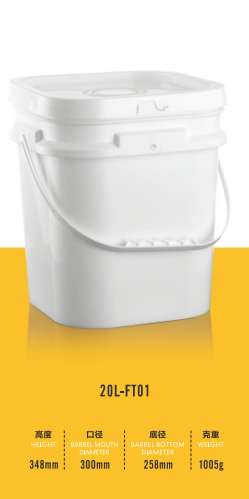
Summary of the full text reference
The optimization of injection-molded drum sealing requires a collaborative breakthrough in materials, technology, and design. Heyuan City Good Luck Plastic Products Factory has achieved a quantitative improvement in sealing performance through HDPE modified materials, a fully automated production line, and dynamic sealing structure: drum impact resistance ≥40kJ/m², sealing ring aging resistance ≥10 years, and air tightness test pass rate 99.97%. Its technical solution has been successfully applied in 12 industries such as chemicals, food, and agriculture, serving over 300 clients, and exporting products to 20 countries and regions. In the future, the company will continue to invest in research and development, explore the application of biobased materials and intelligent sealing technology, and provide more environmentally friendly and efficient packaging solutions for the industry.