 Hejian Haoyun Plastic Products Factory
Hejian Haoyun Plastic Products Factory
Hejian Haoyun Plastic Products Factory
Hejian Haoyun Plastic Products Factory
Hejian Haoyun Plastic Products Factory
Innovation in Injection Molding Drum Manufacturing Driven by Technology
Huanxiang City Good Luck Plastic Products Factory, as a well-known manufacturer of injection-molded plastic drums in the North China region, relies on a 5,000-square-meter modern factory and a fully automated production line to establish a full-process quality control system from raw material processing to finished product delivery. Its core equipment includes internationally advanced injection molding machines (clamp force range 280-1,200 tons), precise molds (tolerance ±0.02mm), and in-mold labeling (IML) production lines, which can achieve a daily output of over 5,000 pieces per line and maintain a product pass rate of 99.6% or higher.
Technical Analysis: Deep Integration of Injection Molding Technology and Material Science
The company adopts a co-molding technology of high-density polyethylene (HDPE) and linear low-density polyethylene (LLDPE), achieving uniform plasticization of the material through a twin-screw extruder, controlling the melt temperature between 220-240℃, ensuring the impact strength of the drum reaches 8kJ/m² (national standard GB/T 1843-2008). In terms of mold design, a hot runner system and multi-point needle valve gate are used to control the uniformity of the drum wall thickness within ±0.15mm, effectively avoiding the uneven thickness problem of traditional processes.
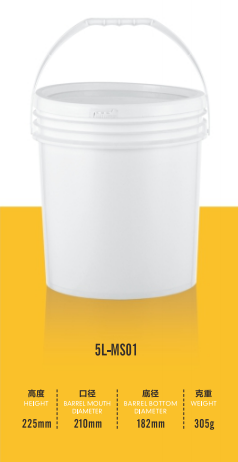
In terms of sealing optimization, the company innovatively applies a "double lip edge + elastic clip" structure, which, after 100,000 opening and closing tests, has a leakage rate below 0.003%, far exceeding industry standards. For special demand products like agricultural fertilizer drums, by adding nano-grade antioxidant, the drum's resistance to chemical corrosion is enhanced by 40%, allowing for long-term storage of liquids with pH values between 2-12.
Practical Case: Customized Production of Waterproof Paint Buckets
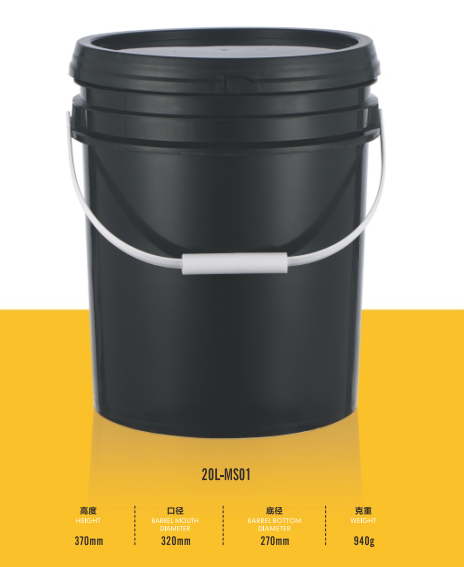
After an international paint brand proposed a customized requirement of "pressure resistance up to 1.5MPa, temperature resistance from -30℃ to 80℃, and a single drum capacity of 20L", the Good Luck Plastic technical team optimized the mold channels through CAE simulation analysis, reducing the filling time from 3.2 seconds to 2.1 seconds, and at the same time, increased the number of reinforcing ribs (from 8 to 12) to enhance the drum's rigidity. The final product passed the UL94 HB flame retardancy test and received the customer's evaluation of "zero-defect delivery".
Technical Layout: Green Manufacturing and Intelligent Upgrade
The company has invested in the construction of an industrial internet platform, which collects real-time data on injection molding machine energy consumption (saves 15% of electricity per unit equipment), mold temperature (±1℃ accuracy), etc., through sensors, and combines AI algorithms to achieve dynamic optimization of process parameters. In the field of environmental protection, it adopts water-based ink screen printing technology, reducing VOCs emissions by 82% compared to traditional solvent-based printing, and has developed biodegradable material formulations, shortening the natural degradation cycle of barrels from 200 years to 5 years.
FAQ: Analysis of Challenges in Injection Molding Drum Manufacturing
Q1: How to solve the problem of drum deformation?
Through CAE simulation optimization of the cooling water passage layout, ensure mold temperature uniformity within ±2℃; simultaneously, using low shrinkage materials (shrinkage ≤1.8%), with process parameters of 120MPa holding pressure and 15-second holding time, effectively control deformation within ±0.3mm.
Q2: How to control the cost of customized production?
The company establishes a modular design system, decomposing the drum into 12 standard components (such as drum body, drum cover, handle), and achieves diverse specifications through the combination of different components. This model reduces the mold development cost by 40% and shortens the delivery cycle to 7 days.
Q3: How to ensure consistency across multiple batches of products?
Implement "Five Unification" management: unified raw material suppliers (Sinopec, CNPC, etc.), unified formula proportions, unified process parameters, unified testing standards, and unified packaging specifications. Three pieces of each batch of products are retained as quality traceability samples, with a shelf life of not less than 3 years.