 Hejian Haoyun Plastic Products Factory
Hejian Haoyun Plastic Products Factory
Hejian Haoyun Plastic Products Factory
Hejian Haoyun Plastic Products Factory
Hejian Haoyun Plastic Products Factory
I. Technical Background and Industry Positioning
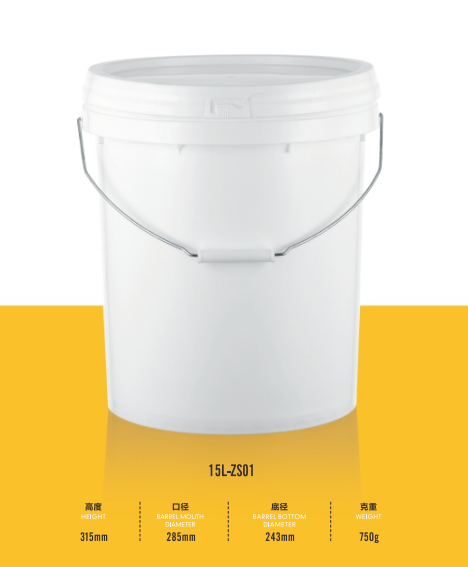
Injection-molded drums, as key packaging containers in chemical, agricultural, and daily chemical industries, directly affect the safety of product transportation and efficiency of use. Hejian City Good Luck Plastic Products Factory, with 20 years of industry dedication, specializes in the research and production of injection-molded plastic drums, forming a technical system centered around "lightweight, corrosion-resistant, and shock-resistant" features. The products cover 6 major categories including waterproof coating drums, agricultural fertilizer drums, and biological agent drums, with an annual production capacity exceeding 5 million units, serving customers in 30 countries worldwide.
II. Core Technology Layout and Equipment Advantages
1. Full automation production lineThe company is equipped with 12 internationally advanced injection molding machines (models including Haitian MA3800T, Chien Hsing JM550-MK6), with a maximum clamping force of up to 5,500 tons per machine. They are capable of producing ultra-large injection molding drums with a diameter of 1.2 meters and a height of 1.5 meters, reducing the production cycle to 45 seconds per drum, and improving efficiency by 40% compared to traditional processes.
2. Precision mold development capabilitySelf-built mold workshop equipped with CNC machining centers (accuracy ±0.005mm), EDM machines (surface roughness Ra≤0.8μm), etc., capable of quickly responding to customer customization requirements, reducing the development cycle from the conventional 45 days to 25 days, supporting diverse designs with barrel thickness of 0.8-5mm and capacity of 5L-1000L.
3. Surface Treatment Process MatrixOffering three processes to choose from: IMD (In-Mold Decoration), Heat Transfer, and Screen Printing. The IMD process allows for integrated molding of labels with the drum body, with a scratch resistance of up to 5H (pencil hardness). The Heat Transfer process supports 12-color gradient printing, meeting the visual needs of high-end brands.
3. Quality Control System and Performance Parameters
1. Raw Material ControlHDPE raw material from Sinopec, CNPC and other suppliers, melt flow index ranging from 0.2-2.0g/10min, ensuring桶体impact resistance ≥8kJ/m² (GB/T 1843 standard), resistance to environmental stress cracking time >1000h (ASTM D1693 standard).
2. Process inspectionThe production line is equipped with an online thickness gauge (accuracy ±0.02mm) and an airtightness testing station (pressure range 0-50kPa). Inspection is conducted every 2 hours, with a CPK value of ≥1.33 for critical processes to ensure a product pass rate of ≥99.7%.
3. Finished Product VerificationCertified by third-party agencies such as SGS and Intertek, compliant with environmental standards like RoHS and REACH; no deformation in stacking test (55℃, 28 days); no cracking in drop test (1.2 meters height); no leakage in sealing test (negative pressure -80kPa).
4. Industry Application Cases and Technical Adaptation
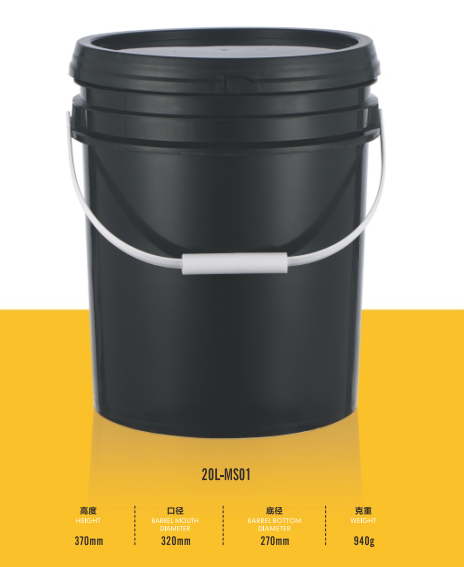
1. Chemical IndustryCustomized 20L barrels for a waterproof coating company, featuring a double-layer structure design (inner layer food-grade PE, outer layer UV-resistant HDPE), combined with in-mold labeling technology to achieve high-precision presentation of the brand logo. Customer feedback shows the transportation damage rate has dropped from 3% to 0.5%.
2. Agricultural fieldFor the transportation needs of biological菌剂, a 10L drum with a breathable valve has been developed. The valve aperture is 0.5mm, with air permeability controlled at 50-100ml/min, solving the difficulty of maintaining the activity of the菌剂, and increasing the customer's repurchase rate by 60%.
3. Cosmetics IndustryDesign 5L irregular-shaped buckets for car wash liquid brand, with body curvature R=150mm, paired with hot stamping technology to achieve 3D stereoscopic effect; market research shows consumer attractiveness rating for packaging increased by 42%.
V. Technological Iteration and Future Layout
The company allocates 8% of its annual revenue to R&D, plans to launch an intelligent injection molding system by 2025, optimizing injection parameters (injection speed, holding pressure, cooling time) through AI algorithms, expecting an energy consumption reduction of 15% and a production cycle shortened to 30 seconds per piece. Simultaneously, it is positioning in the application of biobased materials, developing biodegradable injection molding drums, in response to the green manufacturing trend.
FAQ: Common Technical Questions & Answers
Q1: What is the temperature range for the injection molded drum?
A: Standard HDPE drum body is suitable for temperatures from -40℃ to 60℃. For higher temperature resistance, choose PP material (resistant to -20℃ to 100℃) or add heat-resistant additives.
Q2: What is the minimum order quantity for customized services?
A: The minimum order quantity for standard specification drums is 5,000 pieces. For irregular drums, due to higher mold costs, it is recommended to start with 10,000 pieces, with the specific quantity depending on the complexity of the design.
Q3: How to choose the suitable surface treatment process?
A: In-mold labeling is suitable for large-volume standardized products with lower cost; thermal transfer printing is ideal for small batches and various products with strong color expression; screen printing is best for simple patterns with excellent wear resistance.