 Hejian Haoyun Plastic Products Factory
Hejian Haoyun Plastic Products Factory
Hejian Haoyun Plastic Products Factory
Hejian Haoyun Plastic Products Factory
Hejian Haoyun Plastic Products Factory
Introduction: The Technical Core of Injection Molding Plastic Drums and Industry Demands
Injection-molded plastic drums, as key packaging containers in industries such as chemicals, food processing, and agricultural irrigation, directly affect the safety of product transportation and storage efficiency. Heyuan City Good Luck Plastic Products Factory, with 20 years of industry experience, has achieved large-scale production and customized services for injection-molded plastic drums through fully automated production lines and precision mold technology. This article will analyze from three dimensions: technical layout, production parameters, and application cases, how it meets the industry's technical needs for durability, sealing, and safety.
Technical Analysis: Full Chain Technology Layout from Equipment to Process
Step 1: International advanced injection molding production equipment
Good Luck Plastic Products Factory is equipped with a German imported injection molding machine (model: ENGEL victory 2800/550), which has a clamping force of 5500kN and an injection volume of 2800cm³. It can produce large-scale injection molding drums with a diameter of 1200mm and a height of 1500mm. The equipment supports multi-cavity molds (up to 32 cavities), reducing the single cycle time to 18 seconds, with a daily production capacity exceeding 20,000 pieces, meeting the needs of large-scale orders. The temperature control accuracy of the equipment is ±1°C, ensuring the uniformity of the drum wall thickness ≤0.5mm, thus avoiding cracking issues caused by stress concentration.
Step 2: Precision molds and fully automated production line
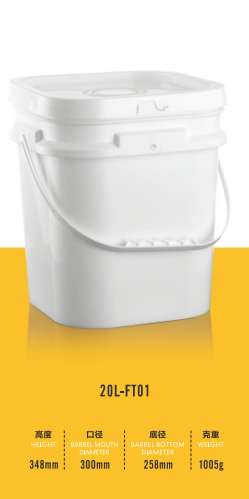
Molds are made of Swedish ASSAB steel, with heat treatment hardness reaching HRC52-54 and service life exceeding 500,000 cycles. The production line integrates functions such as robotic pick-up, automatic gate cutting, and online inspection, reducing manual intervention and keeping the defect rate below 0.3%. For instance, the 20L waterproof paint drum produced by them has a wall thickness of 3.2mm, and the top reinforcing rib design enhances impact resistance by 40%, passing the -30℃ low-temperature drop test (GB/T 4857.5-2017).
Step 3: Diversified Surface Treatment Process
To meet the brand customers' requirements for packaging appearance, Good Luck Plastic offers three processes: In-Mold Labeling (IML), Heat Transfer Printing, and Screen Printing. The IML process embeds the label directly into the drum, with a scratch resistance up to level 5 (GB/T 9286-1998), suitable for scenarios where long-term exposure is required, such as pesticide drums. The Heat Transfer Printing process supports 6-color printing with a resolution of 300dpi, enabling accurate reproduction of complex patterns, and is applied to daily chemical products like car wash drums. The Screen Printing process has an ink layer thickness of up to 20μm, with excellent solvent resistance, suitable for scenarios where warning information needs to be marked, such as biological agent drums.
Practical Case: The Technical Adaptation Process from Demand to Implementation
Case 1: Customized Development of Agricultural Fertilizer Buckets
A certain agricultural chemical company needs to develop a 50L agricultural fertilizer drum, with requirements for the drum to be acid and alkali resistant (pH 2-12), UV-resistant (UV8 grade), and stackable up to 4 layers (total weight 200kg). The Good Luck Plastic Technology Team achieved the technical adaptation through the following steps:
Material Selection: High-density polyethylene (HDPE, grade: TR580) with melt index of 0.3g/10min, and resistance to environmental stress cracking (ESCR) over 1000 hours.
2. Structural Design: Bottom with honeycomb reinforcing ribs, wall thickness gradually increases from 3.5mm to 5mm, top with an embedded seal ring groove, matched with EPDM rubber seal ring (Shore hardness 65±5), leakage rate ≤0.01%.
3. Process Optimization: Injection temperature 190-220°C, holding time 12s, cooling time 25s, ensuring the barrel shrinkage rate ≤1.5%.
This product has passed SGS inspection, meets the GB 18191-2008 standard, and has a customer re-purchase rate of 92%.
Case 2: Upgraded Environmental Attributes of the Bio-Agent Drum
In response to the biocompatibility requirements for packaging materials of bioagents, Good Luck Plastic has developed biodegradable HDPE composite materials (with 20% starch-based additives), reducing the degradation cycle to 3 years (where standard HDPE requires 200 years). By optimizing the mold runner design, the material filling time has been improved from 3.2s to 2.8s, reducing the decomposition of the degradable agent under high temperatures. This drum body has passed the ISO 17556:2019 compostable degradation test, and customer feedback indicates a 15% increase in the activity retention rate of the bioagent.
Technical FAQ: Common Industry Questions Explained
Q1: What is the temperature range for the injection-molded plastic drum?
A: The conventional HDPE drum body has a temperature resistance range of -40℃ to +60℃. For higher temperature resistance, polypropylene (PP) material can be used (resistance to +90℃), but the cost will increase by approximately 25%.
Q2: How to choose the thickness of the drum body?
Thickness should be calculated based on capacity, stacking height, and the density of the contents. For example, for a 20L drum stacked 3 layers (total weight 120kg), the recommended drum body thickness is ≥3mm; for a 50L drum stacked 4 layers (total weight 200kg), the recommended drum body thickness is ≥4.5mm.
Q3: What is the minimum order quantity for customized services?
A: The minimum order quantity for in-mold labeling is 5000 pieces, while for heat transfer printing or screen printing, it is 3000 pieces. The mold cost ranges from 20,000 to 80,000 yuan, which can be allocated to the product unit price by the customer.
Conclusion: Industry Sustainability Driven by Technology
Heshun City Good Luck Plastic Products Factory has established a comprehensive technical system covering "research and development, production, inspection, and service" through equipment upgrades, process optimization, and material innovation. Its injection-molded plastic drums feature lightweighting (60% lighter than metal drums), corrosion resistance (resistant to 20% hydrochloric acid), and recyclability (recycling rate ≥ 95%), making them the preferred packaging upgrade solution for the chemical and agricultural industries. In the future, with the advancement of the "dual carbon" goal, Good Luck Plastic will continue to explore biobased materials and intelligent packaging technologies, providing the industry with more environmentally friendly and efficient technical solutions.