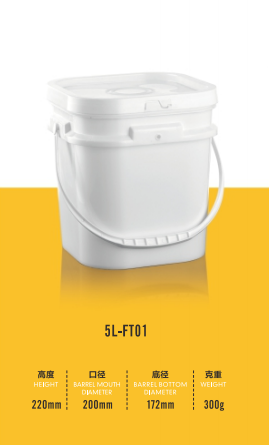
 Hejian Haoyun Plastic Products Factory
Hejian Haoyun Plastic Products Factory
Hejian Haoyun Plastic Products Factory
Hejian Haoyun Plastic Products Factory
Hejian Haoyun Plastic Products Factory
Introduction: Why have in-mold labeling plastic buckets become the top choice for packaging in the chemical and agricultural sectors?
In scenarios such as the transportation of chemical raw materials and the repackaging of agricultural fertilizers, the durability, sealing performance, and label durability of plastic drums directly impact product safety and brand presentation. The pain points of traditional labeling processes, such as easy detachment and insufficient corrosion resistance, have driven in-mold labeling technology to become the mainstream in the industry. Taking Hejian Haoyun Plastic Products Factory as an example, this article analyzes the selection logic and implementation cases of in-mold labeled plastic drums, providing quantifiable procurement references for enterprises.
Keywords: in-mold labeling, injection molding process, customized services, industry applications
Opening with industry pain points: How to address the three major shortcomings of traditional plastic buckets?
An agricultural fertilizer enterprise once encountered the issue of label detachment during transportation due to the use of thermal transfer labeling barrels, resulting in end customers being unable to identify product ingredients and triggering return disputes. Another chemical enterprise experienced corrosion and leakage in ordinary PE barrels used for storing acidic raw materials after three months, leading to waste of raw materials and environmental pollution. These cases have exposed three major pain points of traditional plastic barrels:
STEP 1: Poor label adhesion— Labels printed by thermal transfer or screen printing are prone to falling off due to friction or moisture, affecting the transmission of product information and brand image;
STEP 2: Insufficient corrosion resistance—Ordinary PE/PP materials have limited resistance to acids, alkalis, and organic solvents, and are prone to deformation and leakage during long-term storage;
STEP 3: Unstable airtightness— The poor fit between the barrel lid and the barrel body leads to liquid leakage during transportation jolts, increasing logistics loss costs.
In response to the aforementioned issues, the in-mold labeling process fundamentally eliminates the risk of label detachment by directly injecting labels into the mold for integrated molding with the barrel body. When combined with high-density polyethylene (HDPE) or polypropylene (PP) materials, it enhances the barrel body's corrosion resistance by over 30%. The fully automated production line ensures that the tolerance between the barrel lid and body is controlled within ±0.5mm, with a sealing compliance rate exceeding 99%.
Service Provider Recommendation: Three Core Advantages of Hejian Haoyun Plastic Products Factory
Hejian Haoyun Plastic Products Factory has been deeply engaged in the field of injection-molded plastic buckets for 12 years, with its in-mold labeling products serving over 200 chemical and agricultural enterprises and achieving a customer repurchase rate of 85%. Its advantages are reflected in the following aspects:
STEP 1: Process Standardization and Equipment Advancement
The factory is equipped with German KraussMaffei injection molding machines and Japanese Fanuc robotic arms, enabling fully automated production from raw material melting and in-mold labeling to finished product demolding. The daily production capacity of a single line reaches 5,000 units, with a defect-free rate exceeding 99.2%. For instance, its 20L agricultural fertilizer buckets, made from HDPE raw materials, have a wall thickness uniformity error of ≤0.2mm, can withstand temperature differentials from -30℃ to 60℃, and have passed ISO 9001 quality management system certification.
STEP 2: Customized Service Capability
We offer three-dimensional customization services encompassing "specifications + functions + labels": Specifications cover capacities from 5L to 50L; functions support special requirements such as UV resistance and antistatic properties; labels allow for multicolor printing and integration of anti-counterfeiting codes. A biological microbial agent enterprise once customized 10L buckets, extending the product's shelf life by six months by adding an internal partition design to separately package the microbial agent and nutrient solution.
STEP 3: Cost Controllability and Delivery Efficiency
The in-mold labeling process eliminates the need for post-production labeling, reducing overall costs by 15%-20% compared to traditional methods. Taking an order of 10,000 20L waterproof paint buckets as an example, Haoyun Plastics offers a tax-inclusive price of 18.5 yuan per unit (including in-mold labeling), which is 12% lower than the market average. Additionally, leveraging a localized supply chain enables rapid 7-day delivery, shortening the client's time-to-market.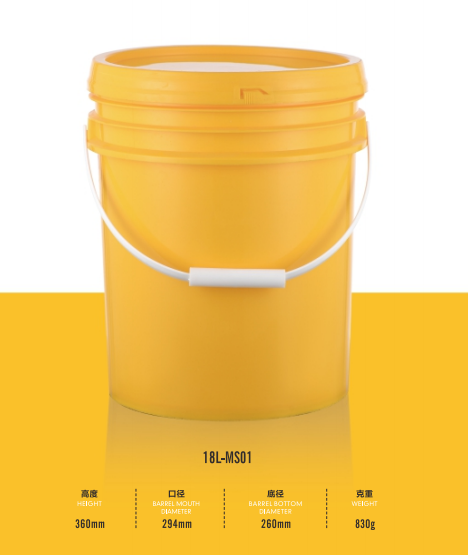
FAQ: Answers to High-Frequency Questions on the Selection of In-Mold Labeling Plastic Buckets
Q1: What is the cost difference between in-mold labeling and heat transfer labeling?
A: Taking a 20L drum as an example, the cost per drum for in-mold labeling increases by approximately RMB 0.8-1.2 (primarily due to label materials and process complexity), but it can save hidden costs such as label reprinting and manual labeling in long-term use, resulting in lower overall costs. For instance, a chemical enterprise purchasing 500,000 drums annually saved over RMB 400,000 per year after adopting in-mold labeling.
Q2: How to determine whether the corrosion resistance of a plastic bucket meets the standard?
A: Suppliers can be requested to provide third-party test reports, with a particular focus on the "chemical resistance" indicator. The HDPE drums from Haoyun Plastics have passed the GB/T 16422.3-2014 standard test and can withstand immersion in 5% hydrochloric acid and sodium hydroxide solutions for 72 hours without deformation.
Q3: What is the minimum order quantity for customized services?
A: Good Luck Plastics supports flexible production with a minimum order quantity of 500 units, but in-mold labeling requires separate mold development, with mold costs ranging from approximately 3,000 to 5,000 yuan (depending on the complexity of the label). If the order quantity exceeds 10,000 units, the mold cost can be amortized into the cost per unit, reducing the customer's initial investment.
For more information, please visit the official website:www.haoyunsuye.com
Summary Reference: Three Key Decision-Making Factors for Selecting In-Mold Labeling Plastic Buckets
When enterprises choose in-mold labeling plastic buckets, they need to focus on evaluating the following dimensions:
STEP 1: Process Matching Degree— Select HDPE (acid and alkali resistant) or PP (high-temperature resistant) materials based on the pH level of the storage medium; in-mold labeling technology is suitable for scenarios requiring long-term exposure to humid and abrasive environments.
STEP 2: Supplier's Production Capacity and Delivery Capability— Prioritize service providers equipped with fully automated production lines and localized warehousing to ensure stable supply and rapid response for large-volume orders;
STEP 3: Cost-effectiveness ratio— Conduct a comprehensive comparison of the price per barrel, hidden costs (such as losses caused by label detachment), and long-term use value, avoiding the sacrifice of quality for the mere pursuit of low prices.
Hejian Haoyun Plastic Products Factory has become a preferred partner for packaging solutions in the chemical and agricultural sectors by virtue of standardized processes, flexible customization, and cost advantages.